Simmering control in a backpacking stove is not a luxury feature — it is a regulated valve problem that engineers solved years ago, and the right stove unlocks it immediately. Five stoves in this guide hold a true low flame under a full pot, weigh between 2.3 and 12 ounces, and start at under $50.
| Photo |
Top Pick

|
Versatile

|
Budget

|
Best Value
|
Best for Reliability

|
|---|---|---|---|---|---|
| Product | Jetboil MiniMo Camping and Backpacking Stove Cooking System | MSR WindBurner Personal Stove System | MSR PocketRocket Deluxe Stove | SOTO WindMaster Backpacking Stove with 4Flex | Fire Maple Polaris Pressure Regulator Cooking System |
| Weight | 14.6 oz (system) | 15.2 oz (system) | 2.9 oz (stove only) | 2.3 oz (stove only) | 12 oz (system) |
| Boil time | 2 min 15 sec per liter | 4.5 min per liter | 3.5 min per liter | Under 2.5 min per liter | Under 3 min per liter |
| Regulator | ✓ | ✓ | ✓ | ✓ | ✓ |
| Simmer control | ✓ | ✓ | ✓ | ✓ | ✓ |
| Buy Now | Check Price → | Check Price → | Check Price → | Check Price → | Check Price → |
Quick Tips
Run the flame test at home before your trip: fill a pot, bring to boil, then back off to the lowest flame you can hold for 60 seconds without extinction — that is your simmer floor.
At altitude above 8,000 feet, canister pressure drops faster; a pressure-regulated stove will outperform an unregulated one by 20-30% in fuel efficiency under those conditions.
Use a pot with a heavy bottom for simmering — thin titanium pots conduct heat unevenly and turn simmering into spot-scorching regardless of how good your flame control is.
Keep your fuel canister warm in cold weather (inside your sleeping bag at night) — a cold canister reduces vapor pressure and makes simmering harder even on regulated stoves.
Jetboil MiniMo Camping and Backpacking Stove Cooking System
Best for cooking real meals solo in the backcountry
Jetboil MiniMo Camping and Backpacking Stove Cooking System
Best for cooking real meals solo in the backcountry
What we like
- Proprietary regulator holds a true low simmer even as the canister empties — one of the most reliable systems available for backcountry cooking.
- Low-profile spoon angle on the 1-liter cooking cup means you can eat directly from the pot without contorting your wrist.
- Push-button ignition is rated to work down to 20 degrees Fahrenheit, which covers most three-season shoulder-season conditions.
- Nesting design packs the stove, pot support, and stabilizer inside the cup — compact and rattle-free in a pack.
What we don't
- The 1-liter cup is a hard limit — cooking for two requires an extra pot or two separate cooking rounds.
- Heavier than open-burner alternatives at 14.6 ounces, which matters on ultralight trips.
- The integrated cup locks you into Jetboil's ecosystem if you want to expand your cookware options later.
The MiniMo's pressure regulator is what separates it from nearly everything else at this weight class — when you dial it back to simmer, it holds there, even at 10,000 feet with a half-empty canister, which is exactly when most stoves start misbehaving. This is the stove for hikers who want to cook actual meals on trail, not just rehydrate bags.
If you are an ultralight minimalist who only boils water, you are paying for capability you will never use.
MSR WindBurner Personal Windproof Camping and Backpacking Stove System
Best for simmering in exposed, windy conditions
MSR WindBurner Personal Windproof Camping and Backpacking Stove System
Best for simmering in exposed, windy conditions
What we like
- Fully enclosed radiant burner design blocks wind from all sides, making it the most weather-resistant simmering stove in this guide.
- Pressure regulator with boil-to-simmer control gives consistent output even with a near-empty canister in cold weather.
- The enclosed system is substantially more fuel-efficient than open-burner stoves in windy alpine conditions.
- Anti-topple remote canister design with self-centering pot keeps your dinner stable on uneven terrain.
What we don't
- Boil time is slower than the Jetboil MiniMo, so it trades peak speed for wind stability.
- The radiant burner and enclosed design make simmering control slightly less fine-grained than the MiniMo's.
- Remote canister setup is bulkier to pack than a top-mount canister stove.
The WindBurner's enclosed burner is not a marketing gimmick — it genuinely insulates the flame from crosswinds that kill other stoves' simmering performance, making it the only stove here that you can trust to hold a sauce at a reliable low heat on an exposed ridgeline. Choose this over the MiniMo if your trips regularly put you above treeline in unpredictable weather.
If you are cooking in sheltered campsites in mild conditions, the MiniMo is the better daily-use system.
MSR PocketRocket Deluxe Ultralight Camping and Backpacking Stove
Best for gram-counters who refuse to sacrifice flame control
MSR PocketRocket Deluxe Ultralight Camping and Backpacking Stove
Best for gram-counters who refuse to sacrifice flame control
What we like
- At 2.9 ounces stove-only, it is the lightest pressure-regulated option in this guide with genuine simmering capability.
- Broad burner head distributes heat more evenly across a pot base than a single-jet design, which makes simmering more consistent.
- The pressure regulator keeps performance steady in cold weather and with a low canister — a huge upgrade over the basic PocketRocket 2.
- Works with any pot you already own, so you are not locked into a proprietary cookware system.
What we don't
- No wind protection — simmering in crosswinds requires you to rig a windscreen or find a sheltered spot.
- The stove-only weight is misleading; you still need a separate pot, which adds 4-8 ounces depending on what you choose.
- Piezo igniter, while durable, is not rated to the same cold-weather performance as the Jetboil systems.
The PocketRocket Deluxe is the right answer when you want simmering control and you have a pot you already love — the broad regulated burner works with nearly any cookware and gives you actual low-flame capability without the integrated system weight penalty. This is the stove for ultralight hikers who want to cook their own food in their own titanium pot, not for anyone who wants a grab-and-go integrated solution.
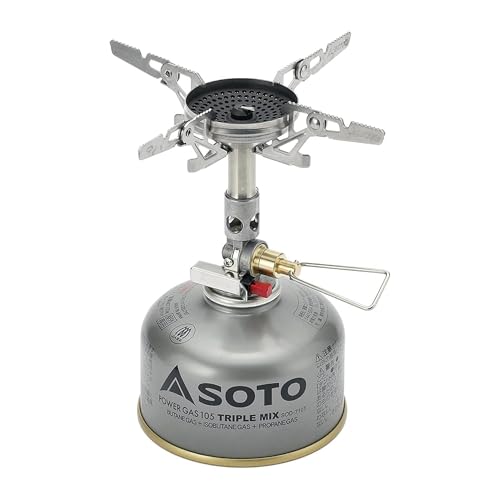
SOTO WindMaster Backpacking Stove with 4Flex
Best for open-flame cooking versatility across pot sizes
SOTO WindMaster Backpacking Stove with 4Flex
Best for open-flame cooking versatility across pot sizes
What we like
- At 2.3 ounces it is the lightest stove in this guide with a built-in micro-regulator and real simmer control.
- The included 4Flex pot support accommodates both small and large pots, giving you cookware flexibility no integrated system offers.
- Built-in micro-regulator maintains consistent output even in cold conditions, rated for performance down to near-freezing temperatures.
- Stealth igniter is recessed inside the burner post, protecting it from impact — more durable than exposed piezo designs.
What we don't
- Requires the 4Flex add-on (included) for larger pots — the default three-prong support is sized for small to medium cookware only.
- Not compatible with 100% propane canisters — isobutane/propane blends only, which limits fuel sourcing in some regions.
- Lighter build means more careful handling is required; it is not as bombproof as the heavier MSR options.
The WindMaster packs the most simmer performance per ounce of any stove in this guide — the micro-regulator is Japanese-engineered and holds a genuinely stable low flame, while the 4Flex support means you can simmer in a full 2-liter pot as easily as in a 750ml cup. This is the stove for hikers who want maximum versatility and minimum weight, and who are willing to be careful with their gear.
If you want something more bombproof to throw in a bag and forget about, the PocketRocket Deluxe is a safer pick.
Fire Maple Polaris Pressure Regulator Cooking System
Best for budget hikers who need regulated simmer control
Fire Maple Polaris Pressure Regulator Cooking System
Best for budget hikers who need regulated simmer control
What we like
- Micro-regulating valve provides real simmer control at a price point well below any Jetboil or MSR WindBurner option.
- Integrated pot and stove system with piezo ignition means everything you need is in one compact package.
- Consistent output in cold conditions — the pressure regulator handles canister pressure drops that crush unregulated budget stoves.
- Electric ignition fires reliably and the system packs neatly with fuel canister inside the pot.
What we don't
- Less refined simmer granularity than the Jetboil MiniMo — the valve range is good but not quite as dialed-in at the lowest settings.
- Integrated system locks you into the included pot, which is fine for most solo hikers but limiting for group cooking.
- Fewer long-term user reviews than MSR and Jetboil, so long-term durability data is more limited.
The Polaris delivers the one thing that matters here — a pressure regulator with a genuine simmer range — at a price that makes the premium stoves in this guide look optional for budget-conscious hikers who just want to cook a proper meal at camp. If you are a weekend hiker testing whether backcountry cooking is worth the investment, this is the stove to start with.
If you are already doing 10+ day-per-year trips in cold and wind, spend up to the MiniMo.
What to Look For
The most important spec for simmering is not BTU output — it is regulator type. A pressure regulator keeps the flame consistent as the canister empties and the temperature drops, which is when you need simmer control most.
Look for a multi-turn valve dial with at least four full rotations of adjustment. One-turn knobs on budget stoves jump from 'off' to 'blast' with almost no usable middle range.
Wind resistance matters more at simmer than at full boil. At low flame, any crosswind disrupts combustion — a recessed or shielded burner head keeps your sauce from going cold mid-cook.
Who Should Skip This
If your only backcountry cooking is boiling water for freeze-dried meals, you do not need a simmer-optimized stove — a lighter, simpler canister stove will serve you better at less cost. Dedicated simmering stoves add weight, mechanical complexity, and price that only pay off when you are cooking real food on trail.
Ultralight gram-counters doing sub-24-hour pushes should also look elsewhere.
What the Community Actually Uses
On r/Ultralight, simmer control is one of the most debated stove specs in the community. The consensus that has emerged over years of trip reports is that integrated systems like the Jetboil MiniMo perform best in cold and wind, while open-burner options like the SOTO WindMaster are preferred by hikers who cook with their own pots and want flexibility across multiple cookware pieces.
Quick Picks — In Case You've Already Decided
Jetboil MiniMo Camping and Backpacking Stove Cooking System
Check Price on AmazonFrequently Asked Questions
Can any canister stove simmer, or do I need a special one?
Most basic canister stoves have a gas knob but no pressure regulator, which means flame output surges as canister pressure changes. A stove designed for simmering has a regulator that smooths out those pressure swings. Without one, true simmering is very difficult to maintain consistently.
Does altitude affect a stove's ability to simmer?
Yes, significantly. At high altitude, lower air pressure means fuel vaporizes differently and canister pressure drops faster. Pressure-regulated stoves handle this much better than unregulated ones. You will notice non-regulated stoves flame out or spike erratically when simmering above 9,000 feet.
Are integrated canister systems better for simmering than open burners?
Integrated systems like the Jetboil MiniMo and MSR WindBurner surround the flame and transfer heat more efficiently, which actually makes low-heat simmering more stable. Open burners give you pot flexibility and are preferred when you want to cook in your own larger cookware.
What fuel canister size works best for a multi-day simmering trip?
For trips where you are cooking real meals twice a day, a 230g canister typically covers 3-4 days of cooking for one person on a regulated stove. Simmering uses more fuel than boiling water, so plan for roughly 10-15 grams of fuel per cooked meal.
Do I need a windscreen with a simmering stove?
It depends on the stove design. Integrated systems like the WindBurner and Jetboil MiniMo have built-in wind protection and do not need a separate windscreen. Open-burner stoves like the PocketRocket Deluxe benefit significantly from a windscreen, especially at low flame settings.
Buying Guide
You need a stove with a pressure regulator — not just a gas knob. A regulator keeps output consistent as canister pressure drops and temperature falls, which is exactly when budget stoves either roar or sputter.
Check for a multi-turn valve: four full rotations gives you real gradient control from whisper-simmer to full boil.